
What Goes Down the Drain
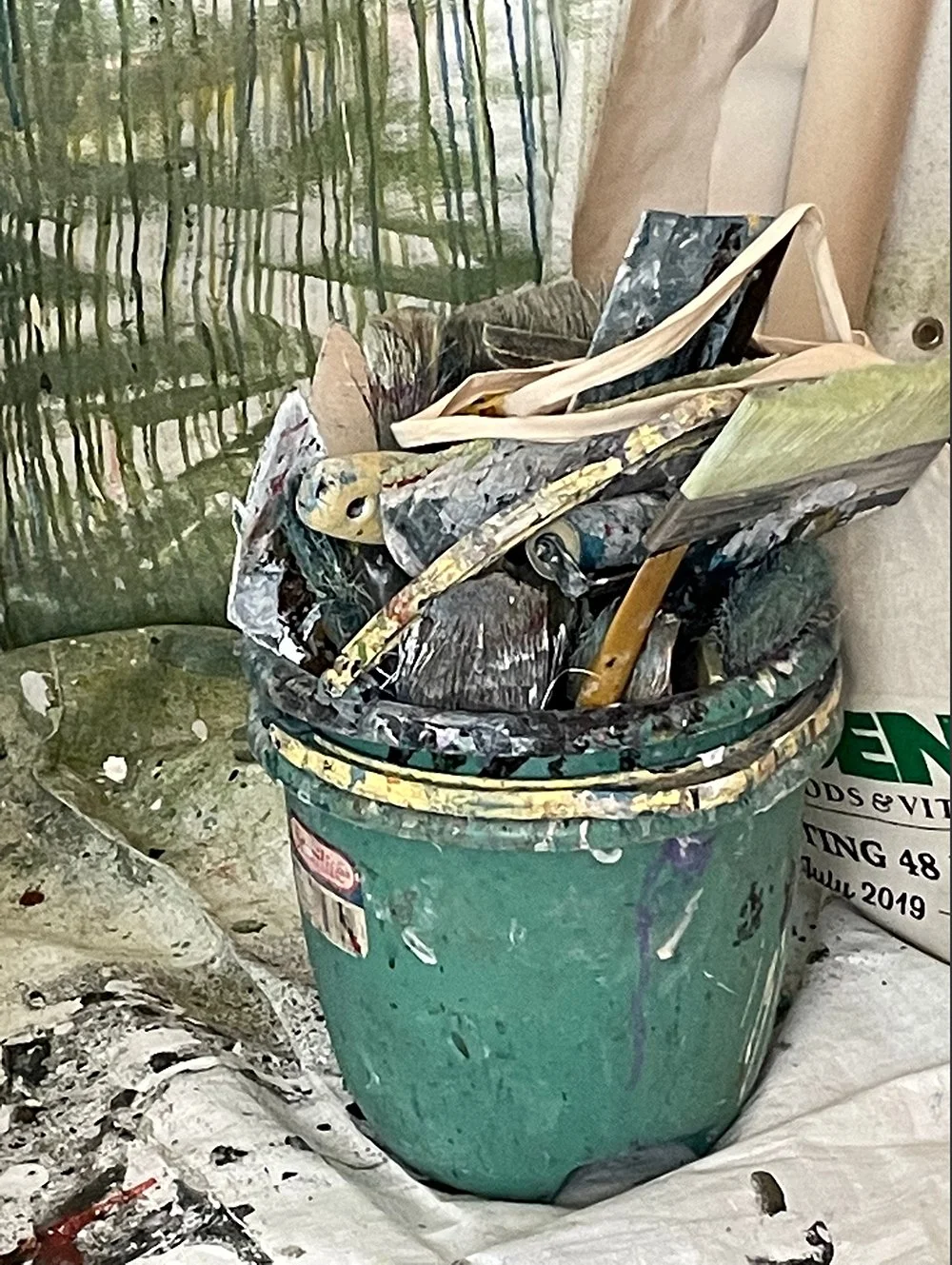
Bucket of water and brushes at the end of a studio session.
There is a bucket in my studio right now that tells you everything about how a painting actually gets made. It is not the painting. It is the water. Brushes soaking, rags gone the color of the week's palette, the sludge at the bottom that used to be titanium white and Payne's gray and whatever red I couldn't stop reaching for. It is not beautiful. It is not something I would ever photograph for its own sake. But it is real, and real is most of what happens in a studio between the moments anyone else ever sees.
For a long time I did the thing most of us do without thinking about it. Rinse the brush, watch the color spiral down the drain, move on. Acrylic doesn't dissolve the way we tell ourselves it does. It is plastic in suspension. It does not disappear just because it goes somewhere we can't see it anymore. I wanted a better way, one that actually fit an apartment life and not a fantasy of a studio with a proper sink trap and a drain built for this. So I built one.
**The idea is simple.** Acrylic paint particles are suspended in water, not dissolved. If you can make them clump together, they will fall out of suspension entirely, and what is left behind is water clean enough to go down the drain with a clear conscience, or better yet, out to the garden. Two additions do the work. Aluminum sulphate acts as a flocculant, it makes the fine paint particles clump into something heavier than water. Hydrated lime neutralizes the pH so what you're pouring out isn't acidic or caustic, just balanced. Both are cheap, both are sitting in the garden or masonry section of any hardware store, and neither one is something you need a chemistry background to use correctly.
**Here is the apartment version**, which is the one I actually use. Two two gallon buckets. Fine mesh paint strainer bags, the kind with an elastic top, from the paint section of the hardware store. A large colander, mine came from a thrift store and has earned its keep many times over. Add the aluminum sulphate and hydrated lime to your dirty water, stir, and let it sit. The particles clump and settle. Strain through the mesh bag into the second bucket, then once more through a folded coffee filter or paper towel for water that's genuinely clear, not just cloudy but safe. What comes through is clear enough to water plants with, and the lime is genuinely good for soil pH, so nothing is wasted, not even the byproduct. I do this about once a week, not after every single session, which makes it a rhythm rather than a chore.
**For a larger studio**, the process scales up simply. Five gallon buckets instead of two gallon. The same strainer bags. For that second, finer pass, commercial coffee urn filters, the large BUNN style ones you can order in bulk, catch what the first strain misses. **One more thing**, because I think it matters more than the practical instructions. The dried strainer bags and used filters do not have to be trash. Save them. What's left behind on the fiber is a kind of accidental chromatography, heavier pigments settle and stain first, lighter ones travel further into the material before they let go. You end up holding a small, unplanned record of a painting's palette, and it is genuinely beautiful collage material. I have started keeping every one. Some of them may end up inside future paintings, byproduct folded back into the work it came from.
I want to be honest about something here, because I looked into it and it surprised me. Dried acrylic does not decompose. It is a plastic, and once it has dried it behaves like one, inert and stable, not something that breaks down the way organic material does. So if collage and cast off materials are not part of your practice, that is completely fine. Once the paint is fully dry, it is no longer suspended in water and cannot wash into any water source, and it becomes ordinary solid waste, safe for the regular trash rather than the drain. But if you do find a way to use those dried filters and scraps in the work itself, that plastic stays contained inside a painting instead of loose in the environment, and it means nothing about the materials you already paid for and used goes to waste either. Both are honest choices. Neither one is pretending the paint disappears.
I am not going to pretend this makes me some kind of environmental authority. I am a painter who lives in an apartment, who moves furniture to make room to work and moves it back so my partner and I have somewhere to sit down at the end of the day, and who got tired of watching a whole palette disappear down a drain like it cost nothing. It costs something. This is just one small, doable way of paying attention to that. I made a one page guide with the full materials list, sourcing links, and steps for both the apartment and larger studio versions, free to download below. Take it, use it, pass it along to anyone else standing at a sink wondering the same thing I was.
A one page guide with the full materials list, sourcing links, and steps for both setups.