The Outside-In and the Inside-Out
Most people look at a realistic painting and know exactly how to "read" it. It’s a familiar language. But when they stand in front of one of my abstract pieces, I often see them searching for a "hook", a house, a face, a tree.
Before the camera lens, the painter was the world’s only recorder. If you wanted to remember what your mother looked like or how the light hit your garden, you needed a realist. But once the camera took over the "outside-in" job of capturing facts, artists were suddenly liberated or, more accurately, fired.
This was the most liberating moment in art history. It forced us to ask: "If the camera captures the facts, what is left for the painter?"
The answer was the Emotional Hook.
In my realistic work, I still look for that hook. I’m not just color-matching a landscape; I’m painting the love of a place. But in abstraction, I skip the middleman. I remove the "place" and paint the emotion directly.
Even when I work in realism today, I’m not trying to compete with your iPhone. I’m looking for the feel of a person or object. With portraiture, if a likeness happens, that’s a plus…maybe. But what you should feel first, is the essence.
A camera sees the green of a leaf. An artist sees how the light at 4:00 PM in West Hollywood turns that leaf into a shard of gold. In realism, the hook is the nostalgia for the place. In abstraction, we simply remove the "leaf" and the "person" and paint the gold and the love directly. We made the emotion the subject.
I’ve heard it in galleries, and I’ve seen it in the comments: "My toddler does that at preschool," or "I could do that in ten minutes... and they want how much for it?"
It’s easy to look at a field of color or a frantic, lyrical line and see a scam. But that’s because we’ve been trained to value art by "labor hours" rather than "emotional weight." Whenever I hear someone say they could do it, my response is simple: Please do. Pick up the brush. Try to balance a canvas using nothing but energy and intuition. Try to make a mark that doesn’t look like a cliché. Try to work from the Inside-Out without a reference photo to hide behind.
Abstraction is harder than it looks. It appears effortless only because the artist has spent years mastering the map of their own psyche. To the untrained eye, it’s a mess; to the artist, it’s a precise navigation of tension and release.
Think of it like Improvisational Jazz. You don't need a music degree to let a saxophone solo hit you in the chest, but if you do understand the technical expertise required, you appreciate the mastery it takes to play "outside" the lines.
When you buy my abstraction, you aren't paying for ten minutes of paint-slinging. You’re paying for:
Decades of self-awareness required to sense those buried feelings.
The courage to be fully present on a blank surface with no safety net.
The unpolished truth of a moment that can never be replicated.
It didn't take me ten minutes to paint that. It took me years of living, failing, and seeing to know exactly where that one "simple" line needed to live.
The next time you stand in front of a canvas, whether it’s a detailed portrait or a wild, lyrical explosion of color, don't ask what the artist was thinking. Ask what you are feeling.
Art isn't a test you pass or fail; it’s a mirror. Realism reflects the world we share; abstraction reflects the soul you carry. Whether I'm working from the outside-in or the inside-out, the goal is always the same: to find the truth of being human. The rest is just paint.
Recommended Reading
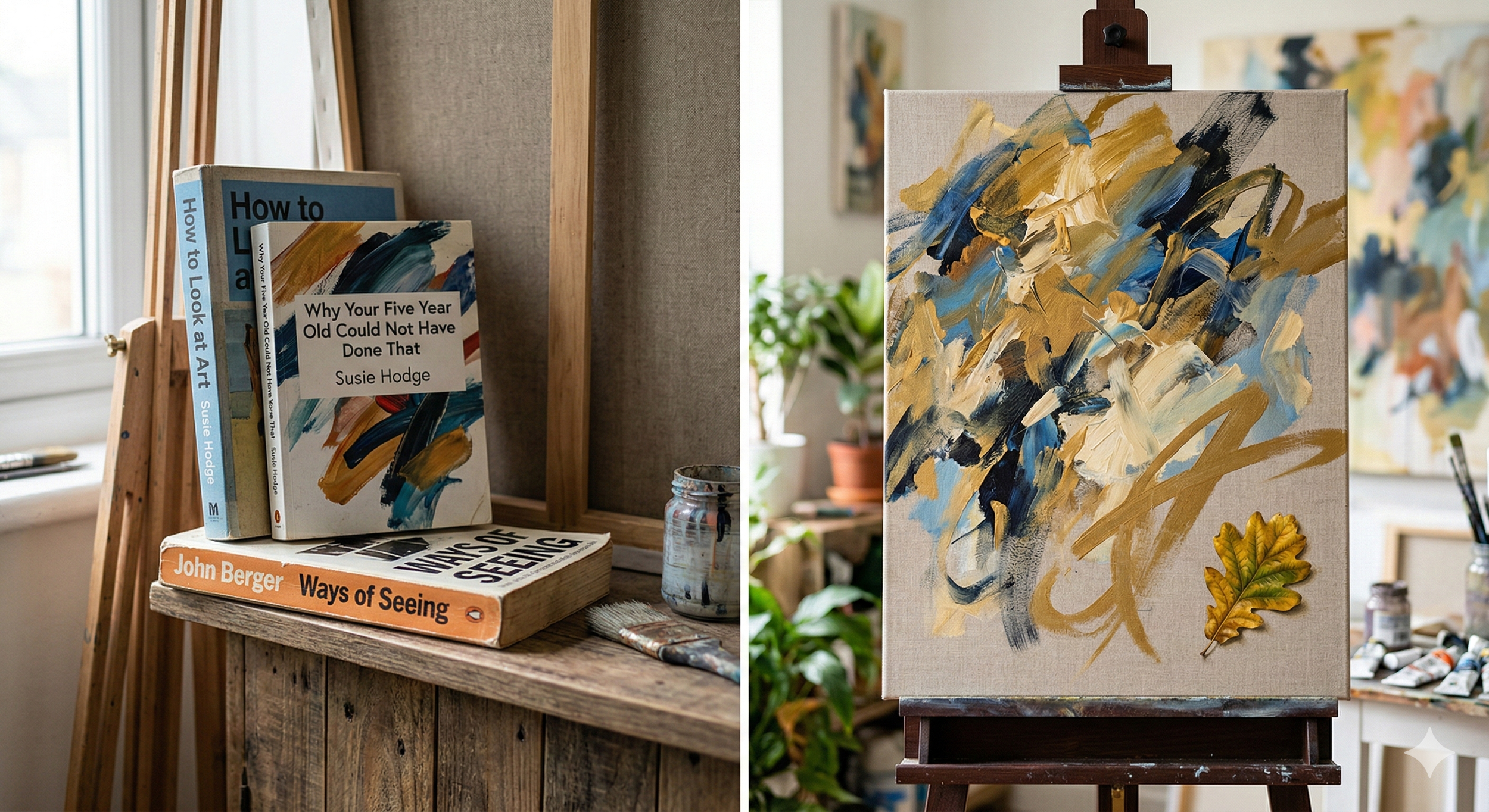
If you want to dive deeper into how to "read" the unseen, I suggest Susie Hodge’s How to Look at Art. She also wrote a brilliant defense of the craft called Why Your Five Year Old Could Not Have Done That. For a deeper look at how the camera changed our perception, John Berger’s Ways of Seeing remains the gold standard.