Painting in a Minor Key
Years ago, in a class with Mary Winterfield, she gave us an exercise that had nothing to do with paint and at the same time, everything to do with paint. She asked us to think of our palette as a chord. A bass note. A middle voice, tenor and alto. A soprano line at the top. Not colors exactly. Tones. She was talking about music, and I got it instantly, because before I ever picked up a brush I had already spent years at a piano, an organ, a flute, and a choir riser, learning that a chord is not one sound. It is several voices agreeing to be heard at once and interestingly ,not always in harmony. It is often the added dissonance that brings the sophistication to sound.
That was the whole idea, and it turns out to be true of a painting the same way it is true of a song. A chord needs a bass note to stand on. It needs a middle to carry the body of the sound. And it needs a top voice, something high, singing and melodic or wandering, without which the whole thing goes empty. A palette works the same way. There is a deep grounding tone that the painting stands on. There is a mid range that gives it body and weight. And there are the high notes, the points of light, the soprano line that makes the eye lift. Not all have to be seen or heard equally, they just need to be there. Take any one voice away and the chord collapses. Winterfield was not really teaching color. She was teaching range.
I have always had an ear for certain kinds of chords. I love a French horn. I love a bassoon, or an oboe, anything reedy and warm and slightly imperfect in the way a human voice is imperfect. In the string section, I will always choose the cello, because the cello has the same timbre as a body, not an instrument. And, I tend to prefer a minor key or a more complicated scale with diminished notes. A major chord is much simpler. It sits down, it lands, it is finished the moment it arrives. Which would not describe my personality in any way. I can be complicated. A minor chord wounds. It asks a question it never quite answers. That is the sound I have always reached for, and it is the same thing I am reaching for with a brush. My paintings do not want to resolve either. They want to make you feel, maybe unsettled, or uncertain, unable to resolve the chord on auto pilot with perfect pitch.
Timbre works the way pigment works. Play the same note on an oboe and on a flute and you get two entirely different colors of sound, even though the pitch never changes. Two paints can sit at the exact same value and still have completely different souls or taste. The character is not in the note. It is in the voice that is singing it. Which is also why you may prefer one voice over another in your choice of music.
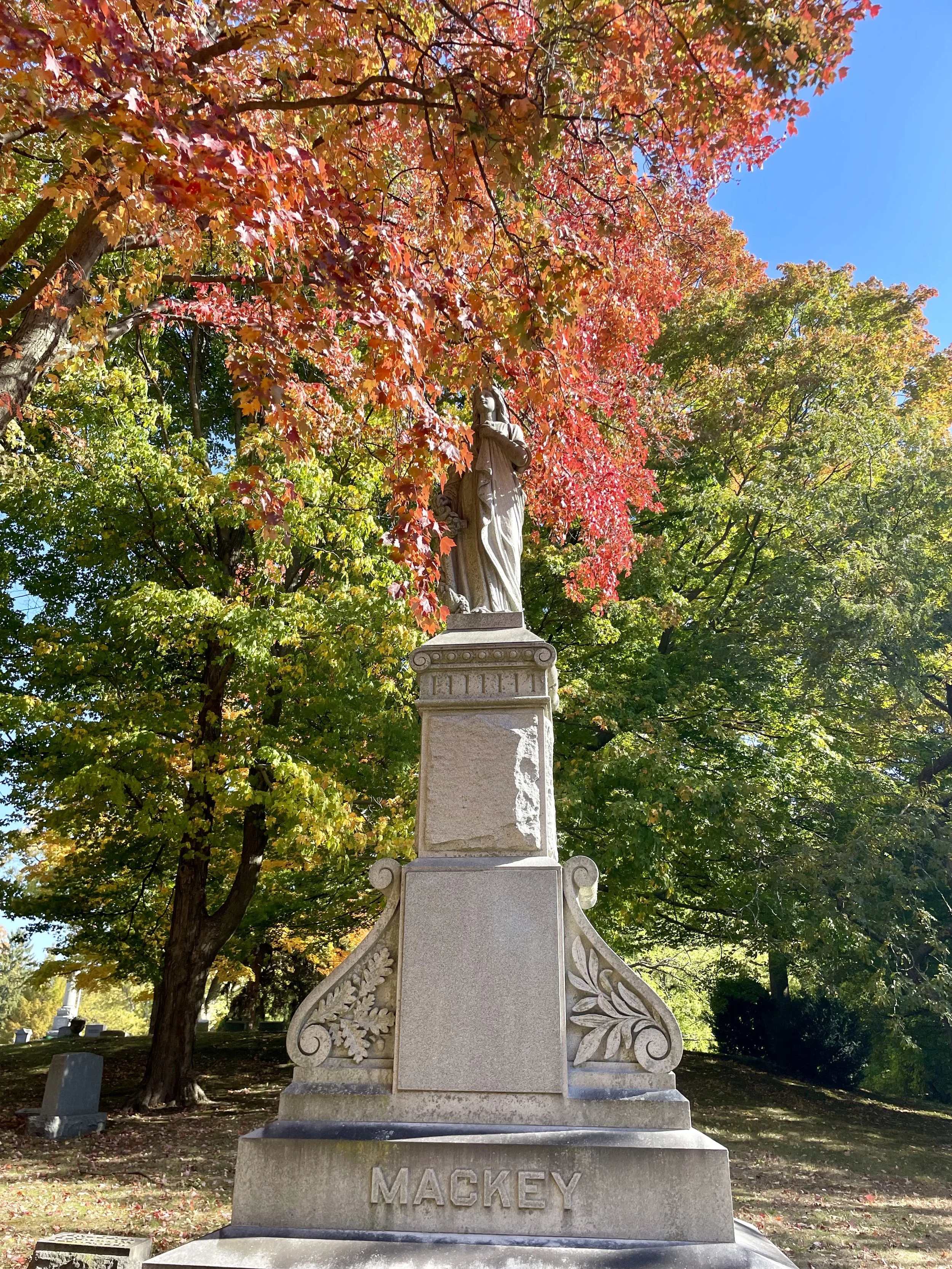
Every season shifts the chord a little, and fall shifts it toward me. Summer asks a painter like me to reckon with too much light, too much major key, a season that wants to resolve when I do not. That does not mean I do not like it. There are beautiful things and complicated things that can happen in summer. It’s just that I have a preference for a more nuanced body response. Fall does the opposite. The days get shorter. The light drops lower and warms as it goes, the way a room feels different once someone turns down the lamp light by half to create ambiance. Golds go umber. Greens go toward rust. Everything leans a little further into the register I already live in. For once the season is not asking me to fight my own instincts. It is agreeing with them. I experience fall’s arrival way before it actually shows up. I used to call those body knowings, my annual period. The body’s primitive reactions know what’s coming, and responds all by itself with a sense of melancholy. And it doesn’t matter that it’s still warm, and the sun is shining. It Knows. Cloud formations change, the color of light changes, so despite what your eyes say, the body responds in order to get ready for what is ahead. Especially when winter falls right behind, and a very cold dark season will be upon us before we know it.
This playlist is what fall sounds like on the inside. These are songs that give me goosebumps, that fill me with nostalgia, or sadness, or that particular fullness or ache that comes from feeling uniquely, unmistakably human. Pat Metheny playing something so unhurried it feels like it is thinking out loud. Sufjan Stevens singing "Chicago" like a memory that is already leaving as he tells it. Bowie asking if there is life on Mars in a voice that already knows the answer does not matter as much as the asking. Rodriguez, half myth and half man, singing "Sugar Man" long before the world caught up to him. Jacob Collier stacking chords so rich they should not resolve and somehow choosing not to. This is music with a bass note, a middle, a tenor and a soprano line all singing at once, the same as the paintings I want to make. I want music I could cry to. Music I could drink a glass of wine to. Music I could kiss someone to. Anything less than that is not the same experience even if pleasant. I want the same out of my paintings.
This is the first in a small series. Four playlists, four seasons, four ways the light rearranges the chord. Fall goes first this year, because fall is where I finally stopped fighting the register I was born into and just let it sing.
Listen to the full Fall playlist here: Music for Looking — Fall