The Face You Brought With You
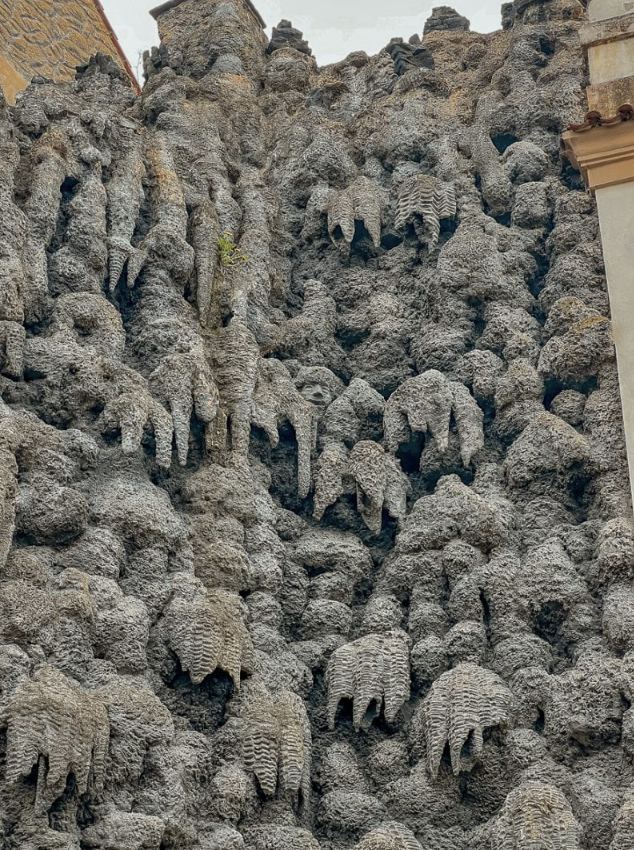
The Dripstone Wall : Wallenstein Garden : Prague
I have been reading Dan Brown lately. Not something I would have predicted about myself, but here we are. In his most recent Robert Langdon novel, The Secret of Secrets, there is a scene set in Prague at the Dripstone Wall in the Wallenstein Garden. It is a real place: a baroque grotto wall built in the 1620s, covered in layers of stone carved to conceal grotesque faces. Frogs, snakes, lions, monsters. They are in there if you look.
A character named Nagel stands before this wall in the dimming light and watches faces materialize in the stone. She has learned something unsettling: only a fraction of the faces she sees were put there by the architect. The rest are faces she is hallucinating. A psychological phenomenon called pareidolia. The brain's deep, hardwired inclination to conjure meaningful shapes out of nebulous contours. Two dots and a line, and most human brains make the same connection.
I read that passage and felt something shift.
Pareidolia is not a glitch. It is a feature. Neuroscientists at Johns Hopkins have described how the brain runs a two-stage process: the visual cortex picks up shapes and edges, routes anything vaguely face-shaped to the same specialized regions that process real faces. The same machinery. Firing with the same urgency. "The brain is so carefully wired to process face information," one researcher put it, "that it's evoked into play as soon as anything even vaguely face-shaped is present."
The evolutionary story makes sense. Before language, before cities, before everything, a human who could rapidly detect a face in the shadows of a forest was a human who survived. The cost of a false positive was low. The cost of a missed predator was everything. So the brain evolved to err generously on the side of seeing. To find presence where there might only be pattern.
What interests me more, though, is what happened to that capacity once the predators were gone. We turned it on clouds, onn wood grain, on fabric and soup and shadows on a lake, on paintings.
There is something researchers call the Goldilocks Zone for pareidolia. Too simple an image and the brain has nothing to work with. Too complex and it becomes visual noise. But in a specific range of ambiguity, somewhere between the empty and the overwhelming, the pattern-seeking brain comes alive. It starts to find things.
Abstract painting, I think, operates almost entirely in that zone.
I did not plan this. I did not set out to make work that would trigger the brain's face-detection machinery. I set out to find presence, to make something that felt alive, to arrive at that moment in the studio where the canvas starts communicating back. But what I made, it turns out, is ambiguous enough to invite the viewer's own neurology into the conversation. And that viewer brings everything. Their history, their hunger, their associations, the particular shape of what they are looking for.
I have had people stand in front of my paintings and tell me what they see. A figure. A landscape. A face in the upper left corner. Something that looks exactly like their grandmother. Something that reminds them of the sea.
Sometimes I can make out what they are describing. Sometimes I genuinely cannot find it.
But here is what I have come to understand: what they are seeing is not wrong. It is not a misreading. It is not a failure to grasp the work. It is the work doing something I did not consciously put there. The viewer's pareidolia is essentially autobiographical. It reveals their own neural history, their own patterns of attention, the particular faces their brain has been trained by decades of living to find.
I used to feel like I should have an answer when people described what they were seeing. Some authoritative account of what the work is actually about. I don't anymore. Abstract painting gives you what you need. Not what the artist intended, not what the title suggests, not what the gallery notes say. What you need. It is not my job to know what that is. My job is to paint. What you see is yours.
The painting leaves the studio. And it starts having a life I did not give it.
Nagel, standing at that baroque wall, could not reliably distinguish between the faces the architect intended and the ones her own brain invented. The experience of standing there was the same either way. The faces felt real. They were real, in the only sense that matters: they were genuinely perceived.
I think about this when I am in the studio. I think about the fact that I am probably doing exactly what Nagel was doing, in reverse. I make work in the ambiguous zone because I am the kind of person who sees things in ambiguous surfaces. I have been doing it my whole life. I am enough of a nerd who sees things to find this almost unbearably interesting.
The maker and the viewer running the same software. You make the ambiguous thing because you are someone who finds meaning in nebulous contours. The viewer finds meaning in what you made for exactly the same reason.
You didn't put that face there.
But you made the wall.
The Secret of Secrets by Dan Brown, published September 2025, is the sixth Robert Langdon novel. The Dripstone Wall at the Wallenstein Garden in Prague is a real place and is open to visitors.